
Ben Lorica and Evangelos Simoudis on AI IP Protection, Navier-Stokes Controversy, Human-Reserved Roles, and Workplace Involution.
Subscribe: Apple • Spotify • Overcast • Pocket Casts • YouTube • AntennaPod • Podcast Addict • Amazon • RSS.
Ben Lorica is joined by Evangelos Simoudis for a wide-ranging discussion on how AI is reshaping knowledge work: from the Navier-Stokes controversy and the need to protect intellectual property to whether workers should still be expected to understand and defend AI-generated work. They explore the loss of apprenticeship, China’s culture of “involution” and what it could mean for Western knowledge workers, differing U.S. and Chinese approaches to AI risk, and close with reflections on the 25th anniversary of 9/11 and its impact on data technology.
Interview highlights – key sections from the video version:
Related content:
- A video version of this conversation is available on our YouTube channel.
- China’s AI Involution
- How AI Is Changing Mathematical Research
- Previous conversations with Evangelos Simoudis can be found here.
- Evangelos Simoudis blog
Support our work by subscribing to our newsletter📩
How AI Is Changing Mathematical Research

Transcript
Below is a polished and edited transcript.
Ben Lorica. All right, so we’re back for our monthly check-in with my friend Evangelos Simoudis. His blog is at corporateinnovation.co. We’re recording this on the morning of September 11, 2026, the 25th anniversary of 9/11. We’ll talk about 9/11 at the end, but let me start with the first topic. As many of you have probably heard, this week there was somewhat of an announcement-slash-controversy around the solution of a very important problem in mathematics called the Navier-Stokes equation, which we don’t have to talk about at all. I happen to have a PhD in math in an area that touches on a lot of differential equations. I took courses from people working on the Navier-Stokes equation, so I’m a little familiar with how difficult that problem is. Long story short, a few weeks ago, maybe a couple of weeks ago, there were some rumors that Anthropic was working on it, which I guess precipitated OpenAI to also work on it. What happened was OpenAI may have, I think, solved a version of it. Anthropic actually wasn’t working on it. A mathematician who works for Anthropic, alongside a mathematician at the Courant Institute, was working on it, and they were actually using a mixture of models, both Anthropic and OpenAI. Anyway, OpenAI then dedicated a tremendous amount of compute to ultimately solve a version of this problem, a much stronger version than what the NYU and Anthropic pairing solved, which is fine. Then there was a lot of drama online about credit and what happened and so on and so forth. There are two issues I wanted to drill down on that might have resonance with the broader AI community. The first directly involves this controversy, which is basically: If you’re working on a problem, should you have some assurance from the model provider that your work is preserved—I mean, private to your efforts? The reason there’s some suspicion is that, if you know something about this problem, there are a lot of different directions that people were trying to attack it from. It just happened to be the case that the people at NYU’s Courant Institute—which, by the way, is probably the leading center for this problem in math—and the person at Anthropic chose a path that was, let’s just say, not as common. But then, at the end of the day, after OpenAI announced the results and people waded through them, it seemed like they chose the same direction. So there’s some suspicion. There’s no smoking gun as to whether or not OpenAI read their prompts and picked up from where they started, and then just happened to apply more compute. But the broader issue here is something that Evangelos and I have touched on about why people are starting to use open-weights models more, trying to run these models on their own clusters. That has to do with IP and protecting IP. That’s one issue. Before I continue, do you have any reaction to that, Evangelos?
Evangelos Simoudis. Yeah. To me, what has been fascinating about this incident is its implications. Number one, the researchers said that they were using Codex for part of their work, right? So this is—
Ben Lorica. Yeah, yeah. This is the whole point. They were actually trying to use a variety of models.
Evangelos Simoudis. As opposed to using Claude. To me, this was fascinating. The second thing was that—
Ben Lorica. Well, why is that fascinating? Because they were functionally independent from Anthropic, right? The person happened to work at Anthropic, but he was collaborating as an independent mathematician with someone at Courant.
Evangelos Simoudis. So here’s why it’s fascinating. As you know, I take the corporate approach a lot. There has been so much noise about the quality and performance of Anthropic’s models, why they are being adopted more broadly, how that has implications for Anthropic’s revenue, and how it makes the company ready to become public before the end of the year. Yet here you have two researchers, one of whom is clearly associated with Anthropic, using OpenAI’s Codex. That’s point number one. Point number two is the fact that OpenAI is taking these prompts, as you say, and using them to improve their model. I mean, they started accepting some of that narrative. That has implications, frankly, for where my mind went: everything that is happening with Chinese models, or what is being claimed about Chinese models—that they are taking, whether through distillation or other means, knowledge from U.S. models. So this is what makes this story extremely important to me, with implications not only for what’s happening in the competition among U.S. labs, but for what’s happening more broadly. And that makes corporations, to your point, think very carefully about how much of their IP they open up to those neo-labs.
Ben Lorica. One point I’ll push back on is this notion that it’s surprising they’re using a variety of models. If you’re a mathematician banging your head against a wall, basically, if you’re using Claude, then okay, let’s try something else. Let’s try another thing, right? So there’s no surprise there if this work was being done as a collaboration between just two people. We’ll use whatever we need to use. Their disadvantage, I think, inherently, is that they didn’t have access to that compute. The amount of compute that OpenAI threw at the problem ultimately was orders of magnitude more than the $1 million Millennium Prize—
Evangelos Simoudis. That—
Ben Lorica. —that they’re not even going to accept anyway, right? So it was mostly for bragging rights. All right. So the first broadly applicable issue, as Evangelos points out, is this notion that maybe your IP is safer if you run models that you ultimately have more control over customizing and deploying. The second issue, which I want to map to another topic that we’ve talked about before, is the impact of this on work itself. A few weeks ago, I think, Bill Gates wrote a massive essay, which I admit I have not read, but I heard an interview with him. There’s one idea there that he drew out: this notion that maybe some work should be fenced off. He had a label called “human reserved.” By that he means it’s not that this work cannot be done by AI or machines, but maybe, for the benefit of society, we might want to set it aside. He had examples like elder care and so on. That got me thinking because, as someone who came out of math, I’ve been following what’s happening in math quite a bit, and there’s a lot of concern about this within mathematics. Mathematics, in many ways, just like coding, is ground zero for this disruption from AI. Some leading mathematicians, like Terence Tao, have something similar, but in many ways much more restricted than what Bill Gates is saying. What Terence Tao is proposing is that maybe we should take a pause because, basically, in math the number of problems people are working on is not infinite. In many ways, it’s a non-renewable resource. If you pick off all of these problems, what happens to the profession of mathematics? These problems lead to insights, which maybe inspire people to go off in different directions. Maybe they get stuck, pursue something else, and then they open up something new. If you solve all of these problems, people stop working on them completely. There’s a rush to start using all of these tools, and maybe we need to take a pause. Of course, these things are impossible to enforce because they’re basically honor-system kinds of things. But mathematicians are starting to say: Let’s have a discussion. Another notion they’ve started putting forward, which I think is also fascinating for business people, is this idea—and I’ve written about this—that the rise of AI has made generating solutions cheap. So now there’s the problem of verification. In certain fields like coding and mathematics, you have tools for formal verification. So, in some ways, verification is also doable. The third thing that is the true bottleneck is validation. What does that mean? Just because you can verify something, someone still has to write a paper, and that paper has to be broadly understandable by human mathematicians before they can accept it for publication. Before the broader community of knowledge workers, which in this case are mathematicians, will sign off, it has to be broadly accepted. Which brings me to another proposal mathematicians have put forward: Maybe a solution should only be accepted if the person who proposes the solution and writes the paper can actually stand in front of an audience of mathematicians and give a talk. In this era where you can write a 5,000-word article in an instant, you can say, “Well, Ben, you wanted a paper. Here’s a paper, and in fact, this paper that you asked me to write can be understood by mathematicians.” But what they’re proposing is another criterion: “Hey, since you’re proposing that your paper is something you wrote, maybe you should give a talk about it.” And, as you know, a talk means that you have to interact with your audience. There are a lot of things to chew on here, but it touches on something Evangelos and I have talked about, which is the elimination of routine work that’s necessary for the apprenticeship process for people to move forward. Anyway, I covered a lot of topics there.
Ben Lorica. To sum up, there’s the notion of human-reserved work. There’s the notion of certain problems, and therefore certain work, being non-renewable. There’s not an infinite supply of this work that you can use to advance a field. In the case of mathematics, these problems lead to insights, which maybe inspire people to go off in different directions. Maybe they get stuck, pursue something else, and then open something up. If you solve all of these problems, people stop working on them completely. Then there’s the notion that generation is cheap. Verification is doable in certain fields like math and coding. Validation—what does that mean? What mathematicians are proposing is that it’s not just a paper. It’s you being able to stand up in front of your peers and actually talk about the result. Anyway, a lot to chew on. I give it to you.
Evangelos Simoudis. A lot to chew on, indeed. But very—
Ben Lorica. Very interesting, right?
Evangelos Simoudis. Very interesting. And I will tell you what I see from the enterprise. If I were to build on what you were saying, the AI technology is advancing much faster than corporations are able to transform. This is creating a lot of friction between supporting or serving the shareholder—which public corporations have a duty to do—and serving the employee. We’re already seeing a lot of that friction emerging in fields like automotive, where we’re starting to see layoffs among both early-career and mid-career employees. How governments, corporations, and employees are going to come together to reach some kind of equilibrium, given the pace at which the technology is advancing, is something that concerns me a lot.
Ben Lorica. So what do you think about this notion of human reserved?
Evangelos Simoudis. I actually think it’s not a dismissible idea. I’ll put it this way: The fact is that we need new ideas, but we cannot continue to apply the playbooks of yore to the problems we’re starting to face. In other words, corporations can no longer say that our primary fiduciary responsibility is to the shareholder, period. They need to start worrying about what this is going to mean to the communities they operate in, to the employees they have, and start coming up with solutions. I also think it’s not fair to expect all of the solutions to come from the government, which I see particularly in Europe. Again, to me, that’s why I keep saying these three constituencies need to start ideating together.
Ben Lorica. A few years ago, there was an initiative that conservatives squashed, which people like Larry Fink took up: the Triple P, right? People, planet, profits. You can’t just optimize for profits. You also have to optimize for people and planet. So this human-reserved idea is almost like recognizing that universal basic income is not enough because people derive meaning from work.
Evangelos Simoudis. Exactly. Time and time again, every experiment that has been run around what work means shows that it means community, it means connection, it means self-worth. It’s not only a means of making a living, of getting a salary.
Ben Lorica. Actually, this ties to an article I sent you recently about the notion that knowledge workers are unhappy. There’s a recognition that a lot of work is basically what has been labeled a “bullshit job.” I’m preparing slides that no one will read, or I’m maintaining spreadsheets that no one will look at, and so on and so forth. Now agents can do that work. But if you have agents do that work, that means people may no longer need work. And, as you pointed out, people derive meaning from going to work and collaborating, even if the collaboration is maybe less impactful than they would want. They’re producing proposals that no one will look at, right?
Evangelos Simoudis. Yeah, and they build networks, particularly. Again, I keep separating this. I recently wrote a report for the European automotive industry. There is a separation—which we don’t make yet—between the impact on the early-career employee versus the mid-career or late-career employee. We cannot treat them all in one bag. We need to start thinking of these segments separately because the needs are different. That’s why I keep saying that I’m starting to see, with the corporations we interact with, that the technology is advancing faster than the transformations they can institute and implement.
Ben Lorica. So what do you think, Evangelos, about the other issue I raised? You have generation, verification, validation, and acceptance. Among mathematicians, they’re saying that for validation and acceptance, not only do you have to write a paper, but you have to be able to present a talk to your peers about the topic. This would be the equivalent in coding of me vibe coding, knowing the code works because I verified it, and then using the same AI tool to generate documentation. But now maybe I also need to stand in front of my team and do a code review or something similar. In math, it’s more like I want to be accepted by my peers, and the ultimate acceptance is that I can actually talk about this topic. But in the professional knowledge-work sense, do we also put a bar like that?
Evangelos Simoudis. From my perspective, as I was seeing you develop your argument, first and foremost, what will have to change on the corporate side is what we value. Think about why automatic programming has become such a big use case, such a successful use case. It’s because corporations talk about reducing the cost of programming and improving the speed with which you create results. Once you take those two as your guiding principles, you don’t care about whether the program is understood by others. All you care about is speed and cost reduction. With mathematics, it’s very different.
Ben Lorica. So how do you then distinguish internally between the so-called star programmers versus the non-star programmers?
Evangelos Simoudis. I’ll give you an example. The point is, if the person whose name is associated with that piece of code leaves, can somebody else come in, take over, build around it, and understand it?
Ben Lorica. No, no. Let’s set that aside. Suppose everyone stays. How do you know who’s your Jeff Dean and Sanjay Ghemawat? You know what I mean? Because everyone is pumping out code right and left.
Evangelos Simoudis. Right. You should be able to say, “I’m part of a team, and I can explain to that team what I’m doing, why I’m doing it, and why I’m making certain choices.” That has to become important. I don’t think it’s important enough today.
Ben Lorica. Like I said, there is this process of code review. What the AI can do is automatically generate the documentation, so then everyone can say their code is documented and tested, because AI can do all those things. But what AI can’t do is replace the fact that I can explain it.
Evangelos Simoudis. Exactly. You need to be able to understand—
Ben Lorica. Which is the same as the mathematician demanding that you should be able to give a talk about your claim to have solved this problem. Give a talk in front of your peers.
Evangelos Simoudis. Right.
Ben Lorica. So then, is that the new test for this? Is Evangelos better than Ben because Ben cannot explain what he vibe coded?
Evangelos Simoudis. I think that should become a criterion if we want—
Ben Lorica. Yeah. How do you distinguish? If you use stack ranking inside your organization, how do you stack rank?
Evangelos Simoudis. Right. But again, I think the competition that exists today, and the criteria that drive this competition, make what you and I are talking about difficult to impose, difficult to accept, and difficult to move forward with. So it has to become a conscious decision by the organization to move in that direction.
Ben Lorica. This has been fascinating because we started out with Navier-Stokes, but, as I pointed out, I was able to pick off broadly important ramifications of this. It just happens that mathematics is almost like the petri dish for this. That’s why I keep talking about what’s happening in math, because I come from that world. Obviously, it’s been many years since I left, but I can see the worry and angst playing out in public.
Evangelos Simoudis. Ben, I don’t want to beat a dead horse here, but I would say that, given how fast things are starting to move, very few people are thinking about the issue you just brought up. I think most of us just move on and try to stay afloat. If that means programming in a specific way or forgoing certain processes, that becomes the driving force. This is unfortunate. It goes back to employment. It has many implications that we do not appreciate right now, and I think by the time we appreciate them, it may be late.
Ben Lorica. I’ll give you the final word, and be brief if you can. We’ve framed this discussion around math and coding, but obviously knowledge work involves more than coding. In coding, we had this notion that you should be able to stand in front of your peers, do a code review, and explain what you did. Do you think this maps to other forms of knowledge work where AI is starting to disrupt things—let’s say designers, people doing writing, or marketing campaigns using AI? What should they be able to do? How would those different clusters of knowledge work be able to distinguish who the better and not-better people are?
Evangelos Simoudis. I think in every type of knowledge work—forget about artistic design for the moment—there is a goal that needs to be achieved. When a corporation says, “I want a new logo,” and the designer comes up and says, “Here is the logo—”
Ben Lorica. Or a law firm where you’re working on a case and obviously they’re using AI. You have five associates. They all have access to the same AI tool. How do you tell which one is—
Evangelos Simoudis. Exactly. Frankly, I’m involved in one situation like this relating to patents, where I’ve caught people not being able to explain why they created certain arguments.
Ben Lorica. So then it seems like the common thing here is this kind of presentation. You have to be able—
Evangelos Simoudis. Yeah. Being able to do this, again, to me, is the human as orchestrator. But as orchestrator, you need to be able to understand the connections. Even if the machine doesn’t give you the connections explicitly, you better be able to say, “Here’s how this thing was arrived at.” If you cannot, I think there are issues with the quality of your work.
Ben Lorica. And I think that makes sense, because it’s very unlikely that the best workers will be the ones who are maestros and geniuses as far as prompting—I mean, crafting the perfect prompt out of the box. It’s the people who are able to interact, use trial and error, and explore. Ultimately, because they’re doing so much interaction with the model, after the fact they might actually be able to explain their work.
Evangelos Simoudis. Exactly.
Ben Lorica. Whereas the person who one-shotted it with one perfect prompt is less likely to be able to explain it.
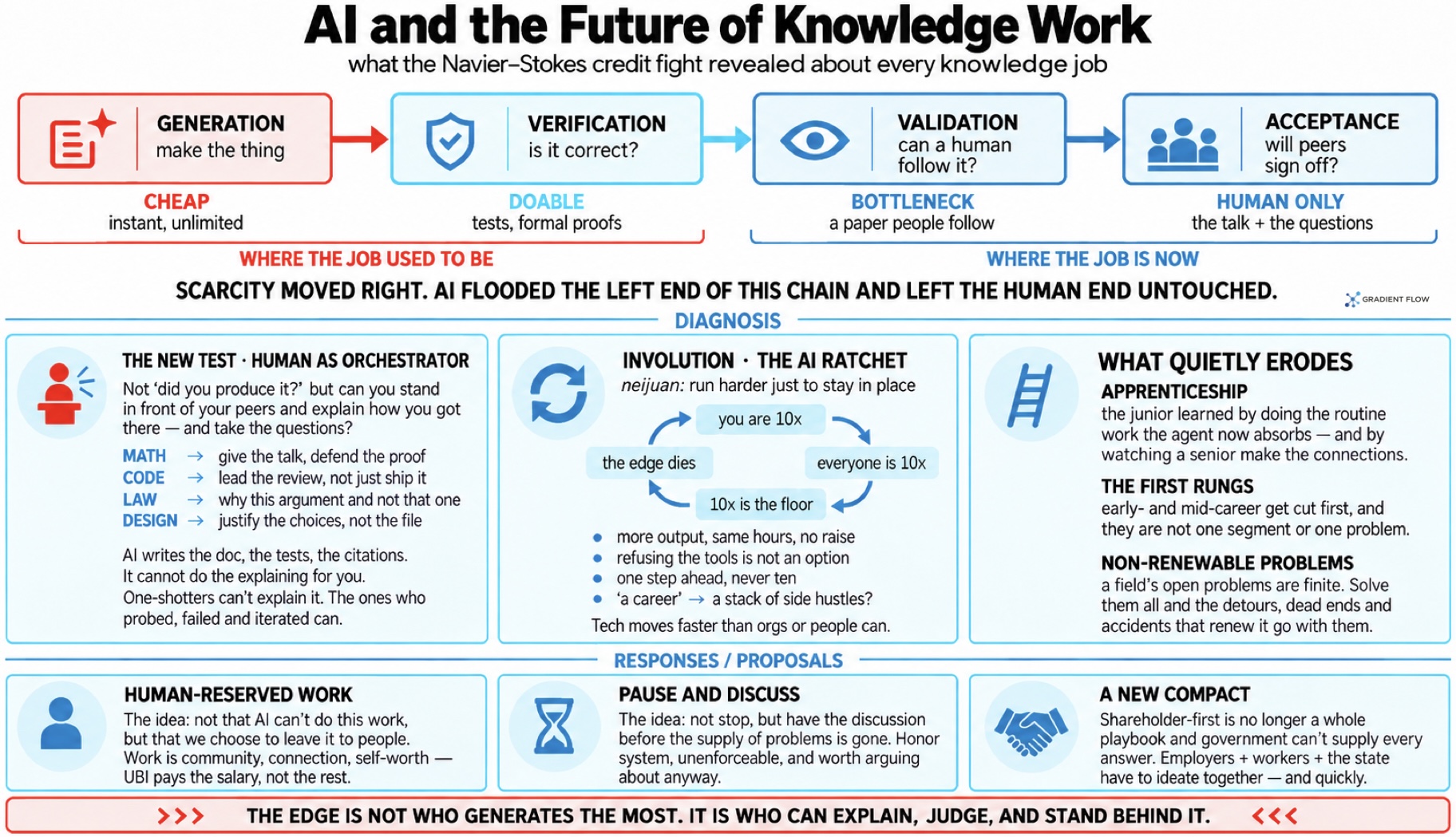
Evangelos Simoudis. And I will end by saying this: What we are starting to lose is this apprenticeship. The young designer who was working with a more senior designer understood how connections were being made. Today, by relying exclusively on an increasingly intelligent assistant, this young designer doesn’t necessarily get that apprenticeship. What we will lose by losing that apprenticeship capability is something that, A, I worry about, but, B, I also admit that I do not know what the next page means. But we’re definitely starting to lose that.
Ben Lorica. Yeah, yeah, yeah. All right, onward to topic number two, which is a topic that I just wrote about. If you follow China, there’s a term they use there called involution, neijuan. Broadly speaking, it means a situation where you have hypercompetition in which everyone has to work harder and improve constantly just to keep up, while the rewards shrink. One way to think about it is: You’re a company, you have an innovation, but then your rivals match it, and your innovation becomes standard. It becomes basically just the cost of entry. Then the cycle begins again. In the meantime, in the consumer space in China, it becomes an expectation. Your food-delivery business can deliver from 5,000 restaurants, find my taste, match me to my taste, and do that cheaply in under 10 minutes. You used to be the only one able to do that, but then quickly people copy you. One more background thing about involution in China is that China, in particular, seems like the perfect setting for involution because it’s a command economy. The national government can set out priorities, which the different provinces then adopt. They all start playing from the same priorities and playbook. Each province will have its champion, and again you have this hypercompetition where margins get squeezed. By the way, that’s an important element here. You keep innovating, people copy you, and then that becomes the expectation. But you can’t raise prices because everyone else has that feature now. Why am I talking about it? Because it seems like there’s something similar happening in AI in China among the open-weights providers.
Evangelos Simoudis. Actually—
Ben Lorica. And also, as an adjacent field to AI in China, the same thing is happening in robotics. The same thing that happened—
Evangelos Simoudis. In cars.
Ben Lorica. In solar, in cars, is now happening in robotics. You have all these humanoid robotics companies, but there’s really not a market for their products. That’s going to be interesting. No one can charge that much money given the level of competition. This actually ties to the previous topic. This notion of involution is playing out, obviously, among the open-weights providers in China because they’re all competing in terms of model capabilities, but also the cadence at which they have to release models. Otherwise, if your model gets stale, people will drop you. Their models also don’t necessarily have switching costs between them in China, so that contributes to this involution. But the reason I bring it up is that it actually also ties to the previous topic, which at a high level was supposed to be about the Navier-Stokes equation, but really came back to knowledge work. Involution, I think, is going to start happening in knowledge work as well. AI gives me certain capabilities. In the beginning, inside my company, I’m the one who’s, “Hey, Ben is the one who’s really great at using these AI tools.” But soon enough, everyone can use the same tool. When Ben became 10 times more productive, we looked to Ben. But now suddenly everyone is 10 times more productive because they learned from Ben how to use these tools, and so Ben’s edge is gone. Then the cycle continues as well. What does involution mean for us as knowledge workers? We’re going to be expected to do more. In China, at least, that means you have to keep the same long hours. You’re probably not going to get a raise, and you can’t be a holdout. If you’re one of these people inside an organization who says, “I’m never going to use these tools,” that’s going to be a problem for you. Involution is a big topic, but we can laser-focus it and tie it back to the previous topic around its impact on knowledge work. By the way, involution is a topic in China that people talk about incessantly, but no one talks about it here in the West. I think that will change as AI exerts similar pressures.
Evangelos Simoudis. Ben, here’s how it is starting to impact the West in a few different sectors that all relate to AI. What is happening in China is, because of the involution, the market can no longer—
Ben Lorica. By the way, were you familiar with this term? Because a lot of people don’t know about this term. It’s been around China for years, right?
Evangelos Simoudis. Yeah. The point is—and we’ve seen this in China—it’s not only that there is this incessant competition among the players, and it’s not only because there are so many players in each subsector. In the automotive sector, there are now over 500 OEMs in China. The problem is that what is being produced as a result of that involution cannot be consumed internally.
Ben Lorica. Yeah, it gets exported. Trade balance.
Evangelos Simoudis. It starts to be exported. We see this, by the way, with AI models, and that causes price depression in the markets that China decides to attack. That has a bigger impact on other markets. And, by the way, it’s not only the economics of the market, but the innovation that can happen locally in those markets.
Ben Lorica. One point I will push back on: I agree with you that involution has been happening, and it’s the reason we have this trade imbalance. But I will push back on the notion that involution is what’s driving these Chinese companies to export their models to the West. I think that’s partly the case, but I also think that’s a strategic move by the Chinese government. “Hey, the West is leading the charge on AI. What’s our angle? Well, our angle is open weights and also cheaper models. Let’s go out there.” Honestly, if the Chinese models could charge more in China, or if they could actually build good companies in China, they might not necessarily focus on the outside market. But I think, in this case, open-weights models are both a great tool for the Chinese government to have a big hand in AI early, because it’s basically still an open field, and also I think the Chinese have—and I’ve interacted with them for years. As you know, I chaired AI conferences in China for years. I’ve done consulting work there. They’ve also been very good at this open-source game: contributing to open-source projects, exerting influence in open standards boards, and things like that. So I would push back a little bit on the notion that involution is the only reason why these open-weights models—
Evangelos Simoudis. No, I’m sorry. Just to be clear about what I’m saying, I was not commenting exclusively on the open-weights models. I was saying that the speed with which China, or Chinese companies, are able to innovate because of this competition created by involution is impacting markets in many different areas. Not only AI.
Ben Lorica. This is why the term involution has actually been a term that China watchers have known for years, because ultimately involution impacts foreign markets. This trade imbalance can largely be drawn to involution. But let’s go back to the point I was trying to connect to the previous topic, which is basically that involution will play out in knowledge work.
Evangelos Simoudis. It will.
Ben Lorica. Right. There’s no specific policy. This goes back to what we talked about in the previous segment around the loss of entry-level jobs. In this case, it’s not necessarily the loss of jobs. It’s just that the expectations for jobs are going to change. I don’t know. Maybe that means you’re going to have to do more work and you’re not going to get a raise.
Evangelos Simoudis. Yes. Your working conditions change dramatically because you need to stay employed, and in order to stay employed, you need to keep innovating. But staying employed doesn’t mean that you’re really advancing. For too long, you’re constantly maybe one step ahead, not 10 steps ahead, and that one step ahead can be covered very quickly by your competitors.
Ben Lorica. And to some extent, that’s a great point, Evangelos. Not only are you staying in place, but is there a way for you to actually stay ahead? Are there certain— I guess it goes back to the earlier discussion we had that there has to be a compact around this. At some point, maybe it’s true that AI can do my whole workflow. But then what does that mean?
Evangelos Simoudis. I also think, Ben, that it’s going to cause organizations to resort to practices that may be in gray areas. I won’t call them unethical, but the competition then takes on a very different meaning, and that has social implications. It has financial implications that I don’t think we’ve appreciated as much as we should.
Ben Lorica. By the way, this reminds me: Involution is happening and impacting you personally as a knowledge worker. You’re constantly having to innovate just to stay in place. This reminds me of something we talked about several episodes ago, which is basically: Does that mean I have to have multiple side hustles?
Evangelos Simoudis. Well, it means that the notion of a career, in the way that you and I grew up with it, is no longer valid. Whether it means that we’re resorting to just gig work as opposed to something more permanent is, again, something that’s at play right now. I keep saying that things are transforming around us, but the technology is moving faster than organizations and individuals can transform. That is creating friction and pressures that I don’t think we yet understand how to address.
Ben Lorica. So, by the way, I talked about involution impacting knowledge work, and I’m just speculating at this point that this might happen. But do you have any anecdotal information? Have you talked to any of your corporate clients who are saying, “Hey, we expect more from these people, and we’re not giving them raises”?
Evangelos Simoudis. No. Actually, I will tell you one thing, again from the automotive industry, which is interesting. In the past, a vehicle program would take somewhere around 48 months from design to manufacture. The Chinese came out and said, “We can do this in 24 months,” and everybody was caught by surprise. Now the Chinese say, “We can do it in 18 months.” The Europeans, on the one hand, are saying we need to—and Tavares, who was the ex-CEO of Stellantis, made this famous saying that if we want to compete with the Chinese, we need to act like the Chinese. More recently, a couple of European automaker CEOs are saying there are limits to how fast we’re going to try to go, because it’s important that we understand certain things and protect our employees and all of that. To me, this was an interesting anecdote. And, by the way, one of the reasons they came up with this is that, in going from 24 to 18 months—I’ll connect it to the verification and validation you were talking about before—we’re now seeing Chinese automakers having a lot more problems with safety and defects. Yes, you can push a car from design to production to hitting the street in, whatever, 18 months, but it may not be as safe as what you’re used to, and now you’re having implications for people’s lives. Again, China is starting to understand that, and the government is starting to understand that, so maybe we’ll see some changes to this continuously accelerating innovation pace.
Ben Lorica. All right, last two topics, both very brief, maybe two minutes each. The first one is AI risks, China and the U.S. What I wanted to say was, it’s interesting to see our U.S. labs talk a lot about societal risk, maybe even the rise of superintelligence that will destroy the human race and things like that, but the Chinese don’t seem to really talk about that. Their notions of risk seem to be much more focused, maybe application-specific, domain-specific. To me, that’s interesting, that divergence between the two. But I also think maybe the common ground is to engage the Chinese on less science-fictional risks and more on practical risks like cybersecurity and bioterrorism. Maybe start there.
Evangelos Simoudis. I agree. Like some other people have said, we’ll see what’s going to be discussed in the upcoming [unclear]-Trump summit later this month, but I think there is an increasing volume around the need to start discussing some of these issues. I think, actually, China has started taking—the Chinese central government has started taking—a few more steps than our government has been taking with regard to safety issues and regulation of those models. But we’ll see what comes out.
Ben Lorica. But our labs seem to be run by people who are immersed in science fiction, rationalism, and effective altruism.
Evangelos Simoudis. Yeah. Look, Ben, I’ve said before that the amount of money that has been invested and is being invested makes decisions for restraint very difficult. How we’re going to reach a balance, again, how we’re going to be able to convince people to adopt a certain pace and take certain actions, is less clear to me right now.
Ben Lorica. All right. Last topic: 9/11. It’s the 25th anniversary. We’ll each do two things. The first thing is: Where were you on 9/11? I was on my way to a job interview when I heard it on the radio. Obviously, the job interview didn’t work out that well because I don’t think we really had an interview. No one was that focused. So where were you on 9/11?
Evangelos Simoudis. When it happened, I was just getting up to start my day. I was saying to my wife this morning that I remember NPR talking about it. At the time, I was with Apex. We had a big office in New York, and we were obviously very worried about our colleagues there. I spent most of the day in the office trying to communicate and make sure that everybody was in good shape. I remember flying to New York two weeks later on business, which was probably the most surreal trip I have taken to the city. I used to travel to New York very, very frequently. But yeah, I was here. I spent most of the day in the office. At that time, our firm was in Menlo Park, and I was trying to make sure that the East Coast colleagues were safe and sound.
Ben Lorica. Yeah, yeah. I had just left the hedge fund, and we did work with traders in those buildings. Luckily, they were okay. So then the second thing about 9/11: Now it’s 25 years later. I’m starting to run into founders who weren’t even born then. They were born after 9/11. Just to refresh the memories of some people as far as tech, what happened after 9/11 was, obviously, there was a lot of awareness around the fact that there were information silos and not a lot of sharing of information. Then there was a big initiative run by the Pentagon called the Information Awareness Project, led by Admiral John Poindexter, which didn’t really play out as they wanted. Fast-forward to 2006, and you started seeing big-data technologies like Hadoop. By 2007, 2008, I started running across startups that were becoming aware that the Pentagon and the government might be good places to sell their wares. Obviously now, fast-forward to today, that hesitance has largely disappeared, and you have the rise of firms like Palantir. Anyway, do you have any stories along these same lines?
Evangelos Simoudis. Actually, I would say that, for me, what was quite central in that transition, if you will, was the realization by the government of the importance of link analysis using commercial tools. Many, many years ago, I had worked in an environment that was developing very proprietary tools to support those types of missions. As a result, there were silos galore. I think the big realization from the analysis of what led to the events of 9/11 was that we really needed much broader connectivity among the data we had, and subsequent analysis of the links that were established. That then became a very important approach that found its way into commercial operations as well and led to big data and techniques to massively analyze that type of data that we were able to bring together. I think 9/11 did much more for data analysis than what we had previously in the 1990s with data warehousing and those kinds of technologies. It showed the importance of bringing together federated and disparate databases.
Ben Lorica. And to our listeners, we will pick up this discussion. We are not necessarily endorsing the surveillance state, but we’ll pick up this discussion in a future episode. I encourage you all to spend the weekend watching a documentary about 9/11. There are a lot of good ones out there on various streaming services. It’s important to remember what happened 25 years ago. And with that, thank you, Evangelos.
Evangelos Simoudis. Thank you.